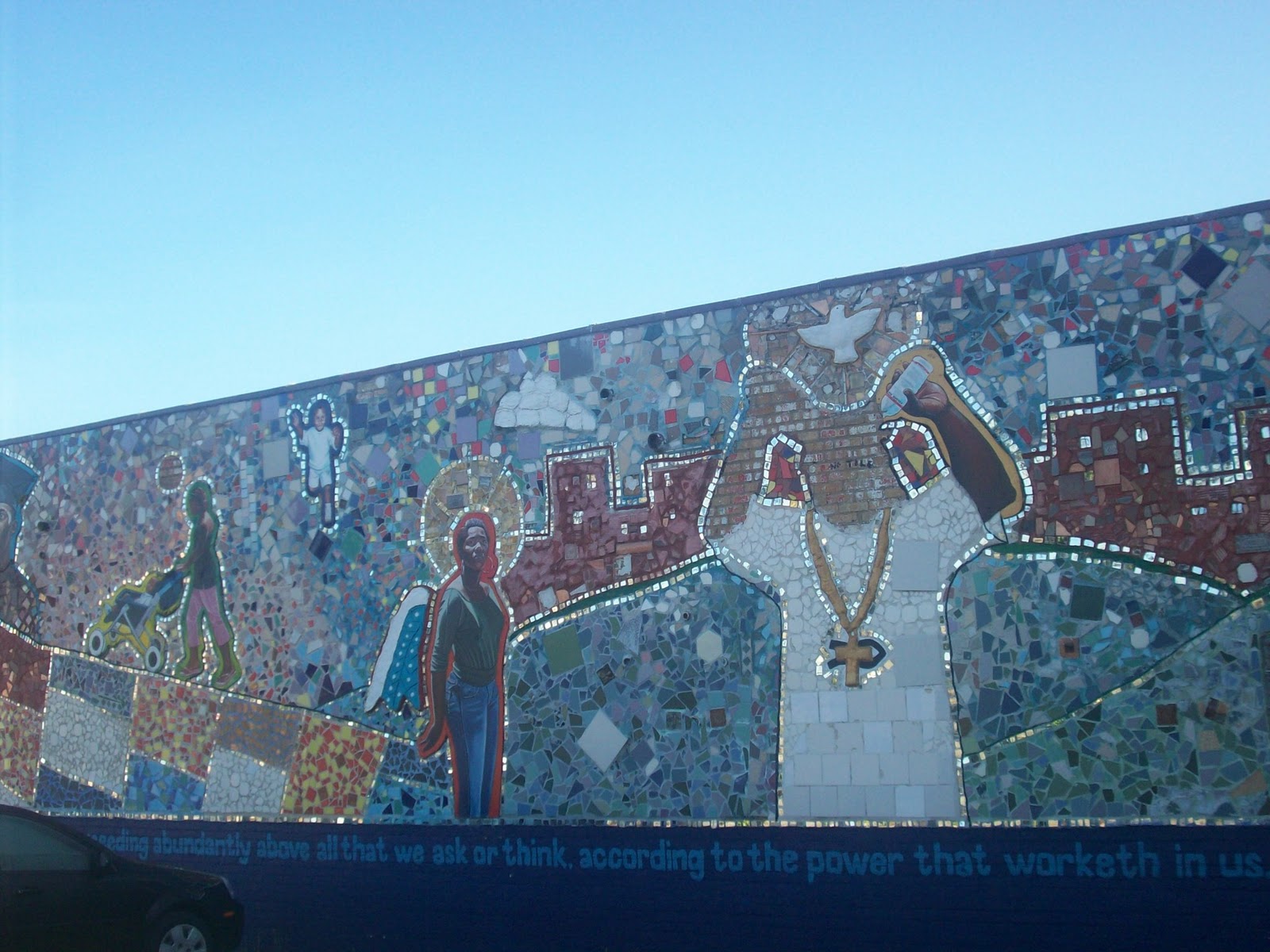
Many Lawndalians have developed an interest in the aesthetic appeal of murals and wall art. It is fair to describe it as a movement. There have always been murals and graffiti, but in recent years there has been a proliferation of the art form. I would attribute this renewed interest to discussions held in the New Community forums lead by Lawndale Christian Development Corporation. Many residents attending some of the meetings designed to get residents to identify issues or strategies they deemed an imperative in helping to revitalize North Lawndale suggested the relatively low cost of public art as a way to soften the hard image of North Lawndale.
One of my favorite murals is located on the west wall of Lawndale Community Church's Harmbee building at 3555 West Ogden Avenue.
Relatively near by is the Fire House Art Center on Hamlin Avenue, between Ogden and Cermak Road. Pastor Phil Jackson is leading this charge.
The Westside Association for Community Action at the northwest corner of Ogden Avenue and South Central Park Avenue is adorned with a remarkable mural showing the organization's founder, Ernie Jenkins, and perhaps the "First Couple" and community heroes, known nationally for their "Slumbuster's Garden," Mr. and Mrs. Earls.
I was extremely surprised to come across this beauty on Douglas Boulevard last Saturday. I was even more surprised - and pleased - to note that the mural includes some Hebrew. How appropriate that Hebrew should be included in a mural on Douglas Boulevard, a mural that also includes Dr. Martin Luther King, Jr. The influence on the built environment and narrative of North Lawndale by the Jewish community is undeniable. Douglas Boulevard was so significant to the Jewish community as Golda Meir was moving around in the basements of the many synagogues and other Jewish institutions engaging in discussions and debates about the nature of Zionism and the need to create a Jewish homeland in the Middle East. Douglas Boulevard was the site of some of King's most prolific talks during the period in which he lived in North Lawndale.
Cermak Road, a dividing line between North Lawndale and South Lawndale (Little Village) appears on the way to becoming a creative corridor. Paderewski School's north wall, facing Cermak recently got dressed-up. The mural reflects the increasing multi-cultural nature of the area.
Bert Downing and Carter's Barbershop has gotten into the act as well. Already the best barber shop on the westside, Bert frequently hosts radio broadcast of Vocalo Radio, and brings topical conversation and debate to the neighborhood. "Breakin' Down Barriers" indeed.
Between Paderewski School and Bert's is a more commercial wall. It, nevertheless, offers a certain level of cleverness to that stretch of Cermak Road.
A new car wash just opened within the past month, just up Ogden Avenue from the Lawndale NHS office. Its elaborate mural runs the entire length of the building, requiring me to take pictures of it in sections.
The Story Book Garden mural in the garden adjacent to the Douglas Library is one of my favorites. Refurbishing the garden was one of the first volunteer projects I was involved with upon coming to North Lawndale. This is also one of the oldest murals in the neighborhood. Unfortunately, I could not get a good picture of it as the foliage has grown and developed nicely.
North Lawndale has one of the most undeniably exotic built environment of any of the city's neighborhoods. With such tremendous Jewish influence, synagogues populated the neighborhood the way that store front churches do currently. There were other significant structures as well, including the first large theaters to be developed in the city. An innovative market-building or creating design was unveiled in the neighborhood by Balaban and Katz. The Central Park and the Lawndale theaters are examples. Ultimately Balaban and Katz took their show on the road and influenced other Chicago movie palaces like the Chicago and the Uptown.
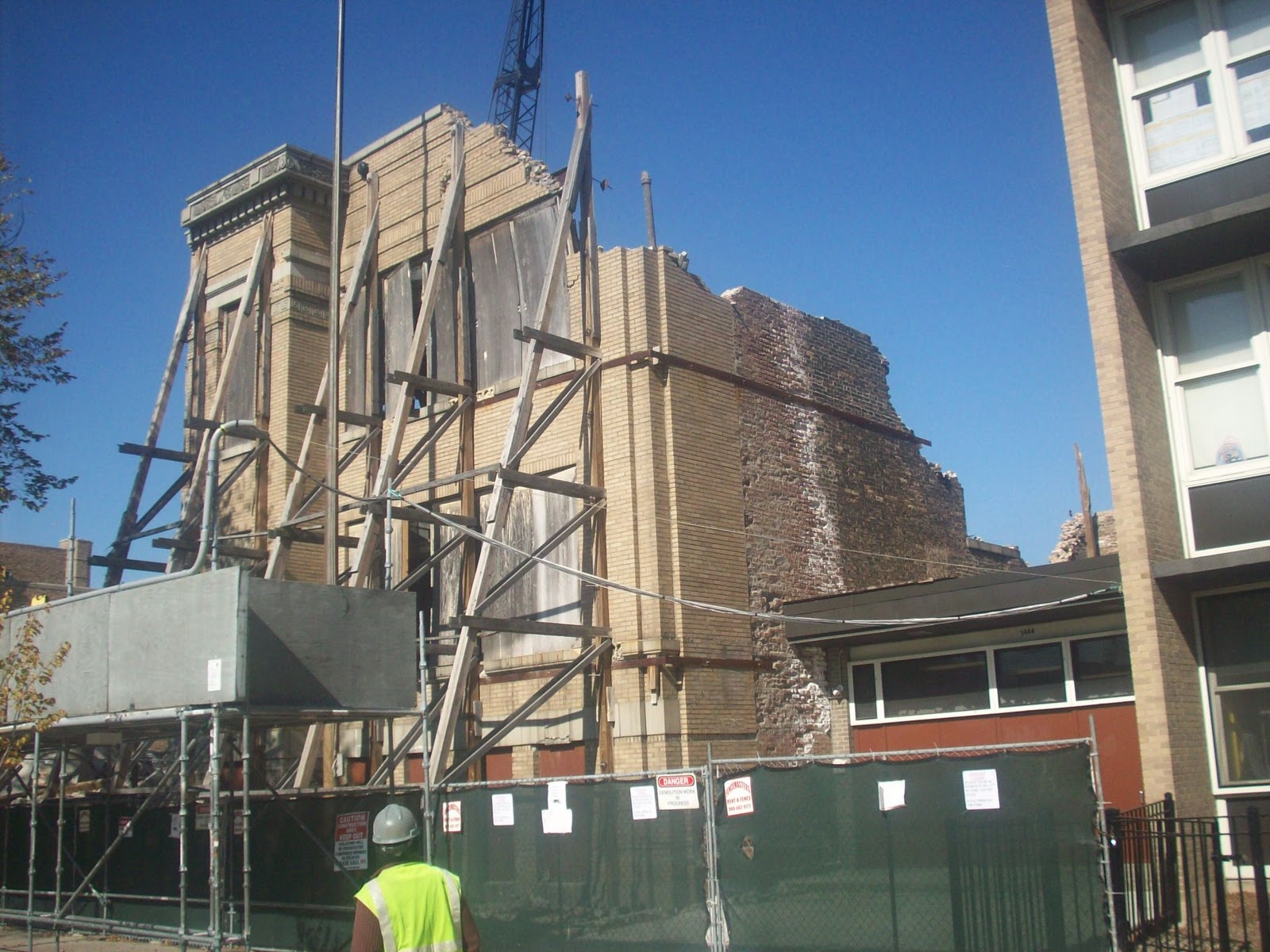
Like a death in the family, North Lawndale most recently lost the old Hebrew Rabbinical Institute or College (shown above). Driving along Douglas Boulevard a couple weeks ago, I was saddened to see the building being demolished. Owned by the Chicago Public School system, the building had not been used for at least twenty years. Scaffolding and braces had been supporting the facade of the building for the past eight years or so to hold it in place. Eventually, time, water damage, and other factors won the battle.
Matt and I were able to salvage a few pieces of the building. Spread out on the floor of my Lawndale office, I don't know how we will use them. But, they are reminders of what we had, and can possible serve an an anchor for a Lawndale museum.
Like Lazarus - or the Hebrew variant, Eleazar - there is an occasional success. Khelath -Jacob at the elbow formed by Independence and Douglas boulevards, as well as having been Benny Goodman's Schul, was dangerously close to demolition. Jim Peters and my good friends at Landmarks Illinois were able to get the building included on their list of most endangered significant buildings in Illinois. Ultimately, Neighborhood Housing Services of Chicago's Redevelopment Corporation was appointed as a receiver by the City of Chicago to try and get the building stabilized. The building was purchased by a Christian congregation which began a renovation of the building.
Khelath-Jacob before renovation
Khelath-Jacob under renovation
But there is still much work to do...
The Lawndale Theater
Shepherd's Temple or the old Anshe Kanesses Israel
When I first begin working in North Lawndale in 1998 I was somewhat aware of its recent, at the time, sociological profile. I knew that it was heavily African-American, and that a disproportionate part of its population had household incomes below the federal poverty level. The demographic information on the community was generally out there in the academic environment. I had looked at demographics on Chicago's community areas in a sociology class at the University of Illinois, and had written a profile of North Chicago for a book of Chicago communities (North Chicago, by Charles M. Leeks and Mary L. Robinson, in: Local Community Fact Book : Chicago Metropolitan Area (1990). Chicago : The Chicago Fact Book Consortium, Dept of Sociology, University of Illinois at Chicago, c1995). This process helped me become aware of Chicago's community structure, including an awareness of North Lawndale. I had heard discussions about North Lawndale in the context of it being a poster child for environmental racism. The Silver Shovel site image was fresh in my mind. But, there was still little written about contemporary North Lawndale at that time, or so I thought. I sat this concern about my perception of a dearth of literature on the community aside for a bit, but did keep a keen eye out for any information about the community.
As I became more grounded in the complex nature of North Lawndale's narrative, Lawndale's Jewish past begin to manifest itself. This was an incredible discovery for me as the buildings that had obviously been synagogues began to appear all around the neighborhood like sentinels... or ghosts, either protecting the community's epic historical moment, or alternatively, guarding its secrets and preventing it from moving forward. At any rate, years of transition, economic disinvestment, racism, and the unintended consequences of massive social policies at the local and national level had obscured the rich narrative. Indeed, the politics that often pit minority groups against each other was the one intangible that was obvious to me, and layered on top of the rich architectural built environment within the community. I was certainly aware of the often contentious dialogue between Cornel West and Michael Lerner in their book Jews and Blacks: A Dialogue on Race, Religion, and Culture in America. I was even more intrigued when I came across the California Newsreel video, Blacks and Jews. What was most compelling about this 85 minute video was the middle 25 or 30 minutes focusing entirely on the relationship between African-Americans and Jews in North Lawndale. It was replete with scenes of blocks in North Lawndale like the 3300 block of West Flourony, and included discussions with current North Lawndale residents like Clyde Ross. I was now completely hooked, and began to look for more written material about North Lawndale. To my surprise, there is considerably more than I realized.
Neighborhood Housing Services of Chicago, with its innovative focus on a dominant housing style in North Lawndale, the Greystone, developed the Historic Chicago Greystone Initiative. Several publications have been spawned by this effort.
Heat Wave: A Social Autopsy of Disaster in Chicago
From The New England Journal of Medicine
Like motorists who slow down to stare at the aftermath of car crashes, most people are fascinated by meteorologic disasters. The perils of weathering a hurricane, a tsunami's destruction of property, and the human drama of a flood all make for riveting tales of struggle and survival. Yet one kind of weather-related catastrophe -- a deadly wave of heat and humidity -- seems not to get nearly the notice given the others, despite the fact that it kills more than all the other kinds combined. Why heat waves are such a quiet menace and how social conditions contributed to more than 700 deaths during a week-long wave of unprecedented heat and humidity in Chicago in 1995 are the focus of Heat Wave: A Social Autopsy of Disaster in Chicago, written by sociologist Eric Klinenberg. The term "social isolation" is usually applied to those living in remote locations, but Klinenberg demonstrates that this unfortunate condition also applies to thousands of people (primarily senior citizens) in our nation's largest cities. And so it was in 1995. Thousands of Chicago's elderly lived alone (many of them in or near poverty), isolated in many ways and by many factors. When the record-breaking heat and humidity arrived and stayed, these men and women started dying, one at a time and quietly, behind closed, locked doors. The immediate reasons were apparent. Many seniors did not have air conditioning in their houses or apartments. Of those who did have air conditioning, many chose not to use it, fearing utility bills that they could not afford to pay. Fear of crime kept others from leaving their homes to use free neighborhood "cooling centers." Still other elderly Chicagoans knew, from a physiological standpoint, that they were hot but were simply unaware that they were in danger. Klinenberg shows in detail how the tragedy was compounded by many factors and interests, including a public health and medical establishment that did not anticipate the magnitude of the looming danger and local news media that treated the severe heat and humidity as little more than a novel topic for lighthearted feature stories. The author also examines key sociological factors relating to the elderly, including the perils of "aging in place" while the surrounding environment changes; the idealization and valuing of personal independence among seniors; and differences between men and women in the establishment of friendships and other interpersonal connections. Heat Wave is a fascinating book, in part because the social conditions that led to Chicago's 1995 tragedy still exist, for the most part, throughout our nation and its aging population. People are still at risk. The book is not without its flaws. Klinenberg strays from sociological analysis and into a politicized attack when he examines the 1995 response of Mayor Richard M. Daley and his administration. He makes far too much of the mayor's brief questioning of exactly what constitutes a "heat-related death" -- a question, I might add, that most of us had at the time. The author erroneously claims that the response of the Daley administration was driven more by public-relations damage control than by a desire to understand the tragedy and prevent further deaths and that a report issued by the Mayor's Commission on Extreme Weather Conditions was little more than "spin," when it was in fact the product of careful deliberation by leading figures in public health, medicine, gerontology, meteorology, and other fields. Indeed, the report laid the groundwork for Chicago's successful response to extreme weather, which was credited with saving hundreds of lives in the summer of 1999. The report has been widely requested by and circulated to public health planners throughout the nation. Other descriptions of the mayoral response are similarly off-base. As a deputy commissioner of the Health Department in 1995, I was there for every step of the action, in front of the cameras and microphones and around the table at meetings about emergency response. Klinenberg and his sources were not there. Klinenberg also puts considerable emphasis on racial disparities in the 1995 heat deaths. (The raw death totals indicate a rough parity between mortality rates in the black and white populations, but age-adjusted rates supplied by the author claim otherwise.) In his biography posted on the Web site of Northwestern University, where he teaches, Klinenberg notes his interest in the exploration of "race as a principle of vision, division, and domination." His focus on race is therefore understandable, but many do not see race as the risk factor that he claims it is. Its flaws aside, Heat Wave is a thought-provoking examination that challenges everyone in medicine and public health to look beyond our training to consider sociological conditions as risk factors. It issues a call for all segments of the population to reestablish those familial and social connections that we once seemed to have but now, all too often, do not. John Wilhelm, M.D., M.P.H.
Historians who write about close friends or relatives do so at their peril. Personal engagement, so essential to the memoir, can confound historical judgment and scholarly detachment, especially when family honor hangs in the balance. Beryl Satter, the chairwoman of the history department at Rutgers University in Newark and the proud daughter of one of the central characters in “Family Properties,” has taken the hard road to glory in her study of race and housing discrimination in Chicago during the 1950s and ’60s. Yet somehow she has managed to stay on course, using her considerable investigative skills and unwavering sense of fairness to write a revealing and instructive book.
She begins with the complicated story of her father, Mark Satter, a Jewish lawyer and landlord who represented “scores of African-Americans who had been grossly overcharged for the houses they had bought.” His legal and real estate interests centered in Lawndale, a traditionally Jewish neighborhood on the West Side of Chicago that became overwhelmingly black by the late ’50s. Lawndale, like many other urban black enclaves, was the scene of widespread and systemic economic exploitation, exacerbated by the Federal Housing Administration’s practice of redlining predominantly black neighborhoods, which effectively eliminated mortgage insurance within their boundaries. In cities like Chicago, redlining forced a vast majority of black homeowners and tenants into the vulnerable world of “contract selling,” in which unscrupulous speculators dictated onerous terms that often led to default and social pathology, simultaneously reinforcing black stereotypes and white racism. The “lack of equal access to credit,” the author explains, had profound ramifications: “fabulous enrichment for speculative contract sellers and their investors, debt peonage or impoverishment for many black contract buyers and an almost guaranteed decay of the communities in which such sales were concentrated.” Once we recognize the full impact of contract selling, she insists, it becomes clear that “the reason for the decline of so many black urban neighborhoods into slums was not the absence of resources but rather the riches that could be drawn from the seemingly poor vein of aged and decrepit housing and hard-pressed but hard-working and ambitious African-Americans.” “Family Properties” is a tale of race and class, but it is not a simple story of white power and black victimization. Irony and ambiguity abounded in a system that often pitted blacks against blacks and sometimes drove men like Satter’s father into moral confusion and financial peril. Indeed, much of the book documents the rising resistance to an unjust system rooted in racial segregation and poverty. Beginning with her father’s truncated legal efforts — he died of a heart attack at the age of 49 in 1965 — Satter traces the community-organizing campaigns of a host of activists, from Saul Alinsky and Martin Luther King Jr. to a series of lesser-known but no less committed individuals. At times, the characters and organizational abbreviations are dished out in mind-numbing proportions, and the specific story lines are not always easy to follow. But no one can accuse the author of glossing over the messy details of life on the ground in Chicago. Neighborhood by neighborhood, block by block, slumlord by slumlord, she takes us through the complex realities of racial division, economic exploitation and local politics. The final chapters focus on the widening reform efforts of the late ’60s and early ’70s, especially the protests organized by the Lawndale-based Contract Buyers League, a grass-roots organization that helped to expose the F.H.A.’s instrumental role in redlining. The league initiated two landmark federal lawsuits, and in 1972 the formation of a broad coalition of housing activists known as National People’s Action set the stage for meaningful reform at the national level. In 1975, Congress passed the Home Mortgage Disclosure Act, and two years later it followed up with the Community Reinvestment Act. Together these laws eliminated some redlining and made life more difficult for predatory speculators, though, as Satter points out, neither measure offered a definitive solution to the problem of racially discriminatory credit practices. As the continuing subprime mortgage crisis demonstrates all too well, the long-term effects of what happened in Lawndale and other black communities a half-century ago are still very much with us. Today we have too many mortgages rather than too few. But the underlying realities of a nation plagued by chronic debt and persistent racial inequality remain the same. A cautionary tale of governmental complicity, “Family Properties” follows the social historian’s dictum of “asking big questions in small places.” It reminds us that history and memory are essential tools for anyone pondering our current predicament.
One of the most compelling reads on Lawndale is by John W. Fountain's True Vine: A young Black Man's Journey of Faith,Hope, and Clarity.
John W. Fountain grew up on some of the meanest streets in Chicago, where drugs, crime, decay, and broken homes consigned so many black children to a life of despair and self-destruction. A father at seventeen, a college dropout at nineteen, a welfare case soon after, Fountain was on the verge of giving up all hope. One thing saved him—his faith, his own true vine.
True Vine is John Fountain’s remarkable story—of his childhood in a neighborhood heading south; of his strong-willed grandparents, who founded a church (called True Vine) that sought to bring the word of God to their neighbors; of his mother, herself a teenage parent, whose truncated dreams help nurture bigger dreams in him; of his friends and cousins, whose youthful exuberance was extinguished by the burdens they faced; and of his religious awakening that gave him the determination to rebuild his life.
An award-winning journalist, Fountain has been a national correspondent for The New York Times, based in Chicago (2000 to 2003), joining the Times from The Washington Post. He is currently a professor of journalism at Roosevelt University in Chicago. Until recently, he was a tenured full professor at his alma mater, the University of Illinois at Urbana-Champaign. Professor Fountain was formerly a visiting scholar at the Medill School of Journalism at Northwestern University in Evanston. He is also working on his second book. His return to Chicago marks how his story has come full circle, this time in triumph.True Vine is an inspiring, moving, gripping story of one man's American dream--a dream that all of us can share.
http://www.johnwfountain.com/truevine.htm provides a good look at his work.
Opened in 1879, Douglas Park covers 173 acres. It was named for Stephen A. Douglas. Douglas, who was a masterful orator, was defeated by Abraham Lincoln, another Illinois U.S. Senator, in the presidential election of 1860. The park, along with Garfield and Humboldt parks, was initially designed by William La Baron Jenney. Jenny used manure from the Union Stock Yards and sand to bolster the site which was relatively marshy.
Jens Jensen became the superintendent of the parks in 1905 and sought to reform the Parks Commission that governed Chicago's western parks. The parks had become relatively dilapidated. Jensen was the Landscape Architect responsible for the "prairie" style that is so evident in Chicago's parks presently.
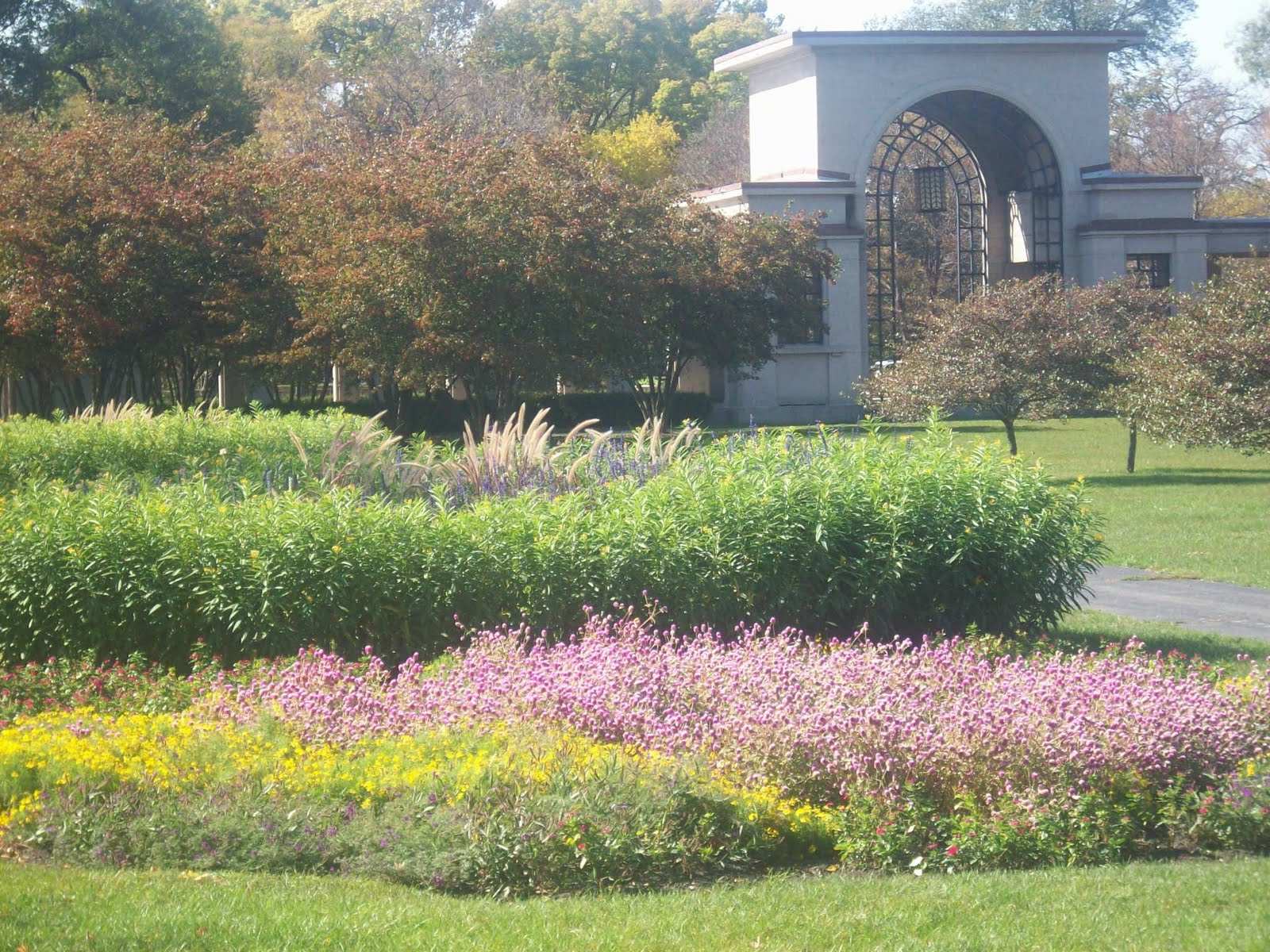
The park serves as a major cultural focus for North and South Lawndale. The park is bisected by Ogden Avenue, creating northern and southern sections. The Douglas Parks Field House in located in the northern end of the park. The Jensen designed pergola and flower garden is at the western edge of the southern section of the park.
Community Partnerships
Ravinia Uses the Arts to Invigorate Communities
Since 1998 Ravinia has partnered with the entire neighborhood of Lawndale, transforming a culturally underserved area into a thriving arts center. Children, adults, even entire families take lessons at the Ravinia Lawndale Community Music Conservatory.
Living in Lawndale since 1998, I have lectured at DePaul University and the University of Illinois at Chicago on public policy and community revitalization... about North Lawndale. I am the director for the North Lawndale program of Neighborhood Housing Services of Chicago. We recently launched the Historic Chicago Greystone Initiative to celebrate Lawndale's unique architecture and built environment. Numerous partners have been involved in this effort with NHS, including: the Driehaus Foundation; Roberta Feldman and the City Design Center of the University of Illinois at Chicago; the National Trust for Historic Preservation; Landmarks Illinois; the City of Chicago; Murphy-Hill Gallery; Lawndale Business and Local Development Corporation; Lawndale Christian Development Corporation; Cook County Commissioners Steele and Steele; block clubs and so very many community residents, most importantly, the Lawndale Historical and Cultural Society. These people and organizations have taught me so very much about the value of partnerships. I must also mention a few other special friends and partners... Susanne Schnell, Professor David Brown; and Art History Professor Robert Bruegmann.




 As I became more grounded in the complex nature of North Lawndale's narrative, Lawndale's Jewish past begin to manifest itself. This was an incredible discovery for me as the buildings that had obviously been synagogues began to appear all around the neighborhood like sentinels... or ghosts, either protecting the community's epic historical moment, or alternatively, guarding its secrets and preventing it from moving forward. At any rate, years of transition, economic disinvestment, racism, and the unintended consequences of massive social policies at the local and national level had obscured the rich narrative. Indeed, the politics that often pit minority groups against each other was the one intangible that was obvious to me, and layered on top of the rich architectural built environment within the community. I was certainly aware of the often contentious dialogue between Cornel West and Michael Lerner in their book Jews and Blacks: A Dialogue on Race, Religion, and Culture in America. I was even more intrigued when I came across the California Newsreel video, Blacks and Jews. What was most compelling about this 85 minute video was the middle 25 or 30 minutes focusing entirely on the relationship between African-Americans and Jews in North Lawndale. It was replete with scenes of blocks in North Lawndale like the 3300 block of West Flourony, and included discussions with current North Lawndale residents like Clyde Ross. I was now completely hooked, and began to look for more written material about North Lawndale. To my surprise, there is considerably more than I realized.
 Neighborhood Housing Services of Chicago, with its innovative focus on a dominant housing style in North Lawndale, the Greystone, developed the Historic Chicago Greystone Initiative. Several publications have been spawned by this effort.